English poet Christopher Smart was admitted to St Luke's Hospital for Lunatics in London, beginning his six-year confinement to mental asylums.
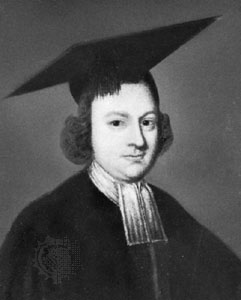
Christopher Smart
Christopher Smart was an English poet. He was a major contributor to two popular magazines, The Midwife and The Student, and a friend to influential cultural icons like Samuel Johnson and Henry Fielding. Smart, a high church Anglican, was widely known throughout London.
St Luke's Hospital for Lunatics
St Luke's Hospital for Lunatics was founded in London in 1751 for the treatment of incurable pauper lunatics by a group of philanthropic apothecaries and others. It was the second public institution in London created to look after mentally ill people, after the Hospital of St Mary of Bethlem (Bedlam), founded in 1246.
Asylum confinement of Christopher Smart
The English poet Christopher Smart (1722–1771) was confined to mental asylums from May 1757 until January 1763. Smart was admitted to St Luke's Hospital for Lunatics, Upper Moorfields, London, on 6 May 1757. He was taken there by his father-in-law, John Newbery, although he may have been confined in a private madhouse before then. While in St Luke's he wrote Jubilate Agno and A Song to David, the poems considered to be his greatest works. Although many of his contemporaries agreed that Smart was "mad", accounts of his condition and its ramifications varied, and some felt that he had been committed unfairly.
Psychiatric hospital
A psychiatric hospital, also known as a mental health hospital, a behavioral health hospital, or an asylum is a specialized medical facility that focuses on the treatment of severe mental disorders. These institutions cater to patients with conditions such as schizophrenia, bipolar disorder, major depressive disorder, and eating disorders, among others.