French Revolution: Maximilien Robespierre (pictured) established the Cult of the Supreme Being as the new state religion of the French First Republic.
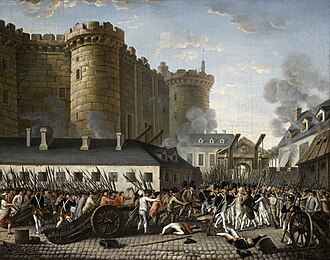
French Revolution
The French Revolution was a period of political and societal change in France which began with the Estates General of 1789 and ended with the Coup of 18 Brumaire on 9 November 1799. Many of the revolution's ideas are considered fundamental principles of liberal democracy, and its values remain central to modern French political discourse. It was caused by a combination of social, political, and economic factors which the existing regime proved unable to manage.
Maximilien Robespierre
Maximilien François Marie Isidore de Robespierre was a French lawyer and statesman, widely recognised as one of the most influential and controversial figures of the French Revolution. Robespierre fervently campaigned for the voting rights of all men and their unimpeded admission to the National Guard. Additionally, he advocated the right to petition, the right to bear arms in self-defence, and the abolition of the Atlantic slave trade.
Cult of the Supreme Being
The Cult of the Supreme Being was a form of deism established by Maximilien Robespierre during the French Revolution as the intended state religion of France and a replacement for its rival, the Cult of Reason, and of Roman Catholicism. It went unsupported after the fall of Robespierre and, along with the Cult of Reason, was officially banned by First Consul Napoleon Bonaparte in 1802.
State religion
A state religion is a religion or creed officially endorsed by a sovereign state. A state with an official religion, while not a secular state, is not necessarily a theocracy. State religions are subject to advantageous treatment by official or government-sanctioned establishments of them, ranging from incentivising citizens to recognise and practice them through government endorsement to having public spending on the maintenance of church property and clergy be unrestricted, but the state does not need to be under the legislative control of the clergy as it would be in a theocracy.