Treaty of Moscow: Soviet Russia recognizes the independence of the Democratic Republic of Georgia only to invade the country six months later.
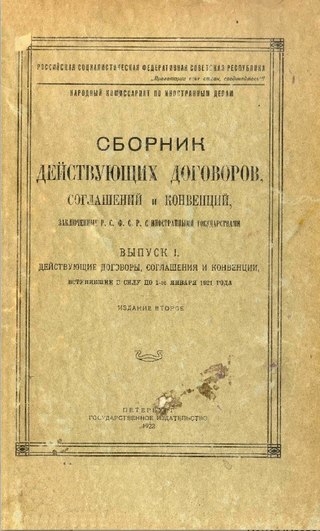
Treaty of Moscow (1920)
The Treaty of Moscow, signed between Soviet Russia (RSFSR) and the Democratic Republic of Georgia (DRG) in Moscow on 7 May 1920, granted de jure recognition of Georgian independence in exchange for promising not to grant asylum on Georgian soil to troops of powers hostile to Bolshevik Russia.
Russian Soviet Federative Socialist Republic
The Russian Soviet Federative Socialist Republic, previously known as the Russian Socialist Federative Soviet Republic and the Russian Soviet Republic, and unofficially as Soviet Russia, was a socialist state from 1917 to 1922, and afterwards the largest and most populous constituent republic of the Soviet Union (USSR) from 1922 to 1991, until becoming a sovereign part of the Soviet Union with priority of Russian laws over Union-level legislation in 1990 and 1991, the last two years of the existence of the USSR. The Russian SFSR was composed of sixteen smaller constituent units of autonomous republics, five autonomous oblasts, ten autonomous okrugs, six krais and forty oblasts. Russians formed the largest ethnic group. The capital of the Russian SFSR and the USSR as a whole was Moscow and the other major urban centers included Leningrad, Stalingrad, Novosibirsk, Sverdlovsk, Gorky and Kuybyshev.
Democratic Republic of Georgia
The Democratic Republic of Georgia was the first modern establishment of a republic of Georgia, which existed from May 1918 to February 1921. Recognized by all major European powers of the time, DRG was created in the wake of the Russian Revolution of 1917, which led to the collapse of the Russian Empire and allowed territories formerly under Russia's rule to assert independence. In contrast to Bolshevik Russia, DRG was governed by a moderate, multi-party political system led by the Georgian Social Democratic Party (Mensheviks).