In the United States, the North American Free Trade Agreement (NAFTA) is approved by the House of Representatives.
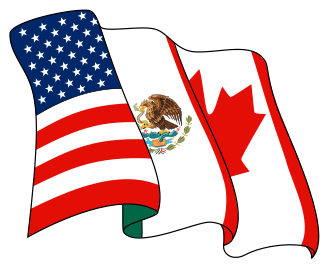
North American Free Trade Agreement
The North American Free Trade Agreement, referred to colloquially in the Anglosphere as NAFTA, was an agreement signed by Canada, Mexico, and the United States that created a trilateral trade bloc in North America. The agreement came into force on January 1, 1994, and superseded the 1988 Canada–United States Free Trade Agreement between the United States and Canada. The NAFTA trade bloc formed one of the largest trade blocs in the world by gross domestic product.
United States House of Representatives
The United States House of Representatives is a chamber of the bicameral United States Congress; it is the lower house, with the U.S. Senate being the upper house. Together, the House and Senate have the authority under Article One of the U.S. Constitution in enumerated matters to pass or defeat federal government legislation, known as bills. Those that are also passed by the Senate are sent to the president for signature or veto. The House's exclusive powers include initiating all revenue bills, impeaching federal officers, and electing the president if no candidate receives a majority of votes in the Electoral College.