The Danish astronomer Ole Rømer presents the first quantitative measurements of the speed of light.
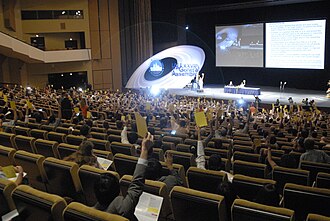
Astronomer
An astronomer is a scientist in the field of astronomy who focuses on a specific question or field outside the scope of Earth. Astronomers observe astronomical objects, such as stars, planets, moons, comets and galaxies – in either observational or theoretical astronomy. Examples of topics or fields astronomers study include planetary science, solar astronomy, the origin or evolution of stars, or the formation of galaxies. A related but distinct subject is physical cosmology, which studies the universe as a whole.
Ole Rømer
Ole Christensen Rømer was a Danish astronomer who, in 1676, first demonstrated that light travels at a finite speed. Rømer also invented the modern thermometer showing the temperature between two fixed points, namely the points at which water respectively boils and freezes.
Rømer's determination of the speed of light
Rømer's determination of the speed of light was the demonstration in 1676 that light has an apprehensible, measurable speed and so does not travel instantaneously. The discovery is usually attributed to Danish astronomer Ole Rømer, who was working at the Royal Observatory in Paris at the time.
Measurement
Measurement is the quantification of attributes of an object or event, which can be used to compare with other objects or events. In other words, measurement is a process of determining how large or small a physical quantity is as compared to a basic reference quantity of the same kind. The scope and application of measurement are dependent on the context and discipline. In natural sciences and engineering, measurements do not apply to nominal properties of objects or events, which is consistent with the guidelines of the International Vocabulary of Metrology (VIM) published by the International Bureau of Weights and Measures (BIPM). However, in other fields such as statistics as well as the social and behavioural sciences, measurements can have multiple levels, which would include nominal, ordinal, interval and ratio scales.