Timur of Samarkand captures and sacks the Georgian capital of Tbilisi, taking King Bagrat V of Georgia captive.
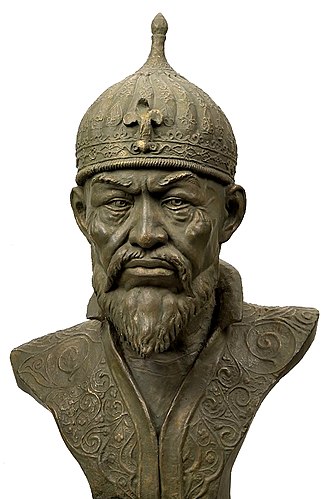
Timur
Timur, also known as Tamerlane, was a Turco-Mongol conqueror who founded the Timurid Empire in and around modern-day Afghanistan, Iran, and Central Asia, becoming the first ruler of the Timurid dynasty. An undefeated commander, he is widely regarded as one of the greatest military leaders and tacticians in history, as well as one of the most brutal and deadly. Timur is also considered a great patron of art and architecture, for he interacted with intellectuals such as Ibn Khaldun, Hafez, and Hafiz-i Abru and his reign introduced the Timurid Renaissance.
Timurid invasions of Georgia
The Timurid invasions of Georgia were eight invasions between 1386 and 1403 of the Kingdom of Georgia in the Caucasus by the Timurid Empire. Led by Timur, the Timurids ultimately conquered the Christian monarchy and made it a tributary state that kept its independence and religion.
Kingdom of Georgia
The Kingdom of Georgia, also known as the Georgian Empire, was a medieval Eurasian monarchy that was founded in c. 1008 AD. It reached its Golden Age of political and economic strength during the reign of King David IV and Queen Tamar the Great from the 11th to 13th centuries. Georgia became one of the pre-eminent nations of the Christian East, and its pan-Caucasian empire and network of tributaries stretched from Eastern Europe to Anatolia and northern frontiers of Iran, while Georgia also maintained religious possessions abroad, such as the Monastery of the Cross in Jerusalem and the Monastery of Iviron in Greece. It is the principal historical precursor of present-day Georgia.
Tbilisi
Tbilisi, in some languages still known by its pre-1936 name Tiflis, is the capital and largest city of Georgia, located on the banks of the Kura River. With around 1,330,217 inhabitants, it contains almost one third of the country's population. Tbilisi was founded in the fifth century AD by Vakhtang I of Iberia and has since served as the capital of various Georgian kingdoms and republics. Between 1801 and 1917, then part of the Russian Empire, it was the seat of the Caucasus Viceroyalty, governing both the northern and the southern sides of the Caucasus.