Second Nagorno-Karabakh War: An armistice agreement is signed by Armenia, Azerbaijan and Russia.
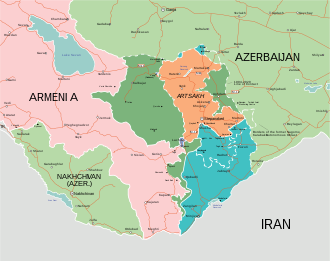
Second Nagorno-Karabakh War
The Second Nagorno-Karabakh War was an armed conflict in 2020 that took place in the disputed region of Nagorno-Karabakh and the surrounding occupied territories. It was a major escalation of an unresolved conflict over the region, involving Azerbaijan, Armenia and the self-declared Armenian breakaway state of Artsakh. The war lasted for 44 days and resulted in Azerbaijani victory, with the defeat igniting anti-government protests in Armenia. Post-war skirmishes continued in the region, including substantial clashes in 2022.
2020 Nagorno-Karabakh ceasefire agreement
The 2020 Nagorno-Karabakh ceasefire agreement was an armistice agreement that ended the Second Nagorno-Karabakh War. It was signed on 9 November by the President of Azerbaijan Ilham Aliyev, the Prime Minister of Armenia Nikol Pashinyan and the President of Russia Vladimir Putin, and ended all hostilities in the Nagorno-Karabakh region from 00:00, on 10 November 2020 Moscow time. The president of the self-declared Republic of Artsakh, Arayik Harutyunyan, also agreed to an end of hostilities.
Armenia
Armenia, officially the Republic of Armenia, is a landlocked country in the Armenian highlands of West Asia. It is a part of the Caucasus region and is bordered by Turkey to the west, Georgia to the north and Azerbaijan to the east, and Iran and the Azerbaijani exclave Nakhchivan to the south. Yerevan is the capital, largest city and financial center.
Azerbaijan
Azerbaijan, officially the Republic of Azerbaijan, is a transcontinental and landlocked country at the boundary of West Asia and Eastern Europe. It is a part of the South Caucasus region and is bounded by the Caspian Sea to the east, Russia's republic of Dagestan to the north, Georgia to the northwest, Armenia and Turkey to the west, and Iran to the south. Baku is the capital and largest city.