The Motherland Calls, a colossal statue in Volgograd, Russia, which commemorates the casualties of the Battle of Stalingrad, was dedicated, becoming the then-tallest statue in the world.
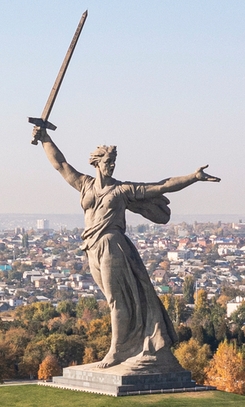
The Motherland Calls
The Motherland Calls is a colossal neoclassicist and socialist realist war memorial sculpture on Mamayev Kurgan in Volgograd, Russia. Designed primarily by sculptor Yevgeny Vuchetich with assistance from architect Yakov Belopolsky, the concrete sculpture commemorates the casualties of the Battle of Stalingrad, and is the predominant component of a monument complex, which includes several plazas and other sculptural works. Standing 85 metres (279 ft) tall from the base of its pedestal to its peak, the statue was the tallest in the world upon its completion in 1967, and is the tallest statue in Europe if including the pedestal. The statue, along with the rest of the complex, was dedicated on 15 October 1967, and has been listed as a tentative candidate for UNESCO's list of World Heritage Sites since 2014.
Volgograd
Volgograd, formerly Tsaritsyn (1589–1925) and Stalingrad (1925–1961), is the largest city and the administrative centre of Volgograd Oblast, Russia. The city lies on the western bank of the Volga, covering an area of 859.4 square kilometres, with a population of slightly over one million residents. Volgograd is the 16th-largest city by population size in Russia, the third-largest city of the Southern Federal District, and the fourth-largest city on the Volga.
Battle of Stalingrad
The Battle of Stalingrad was a major battle on the Eastern Front of World War II, beginning when Nazi Germany and its Axis allies attacked and became locked in a protracted struggle with the Soviet Union for control over the Soviet city of Stalingrad in southern Russia. The battle was characterized by fierce close-quarters combat and direct assaults on civilians in aerial raids; the battle epitomized urban warfare, and it was the single largest and costliest urban battle in military history. It was the bloodiest and fiercest battle of the entirety of World War II—and arguably in all of human history—as both sides suffered tremendous casualties amidst ferocious fighting in and around the city. The battle is commonly regarded as the turning point in the European theatre of World War II, as Germany's Oberkommando der Wehrmacht was forced to withdraw a considerable amount of military forces from other regions to replace losses on the Eastern Front. By the time the hostilities ended, the German 6th Army and 4th Panzer Army had been destroyed and Army Group B was routed. The Soviets' victory at Stalingrad shifted the Eastern Front's balance of power in their favour, while also boosting the morale of the Red Army.