German astronomer Johannes Kepler began observations of an exceptionally bright object, now known as Kepler's Supernova, that had appeared in the constellation Ophiuchus.
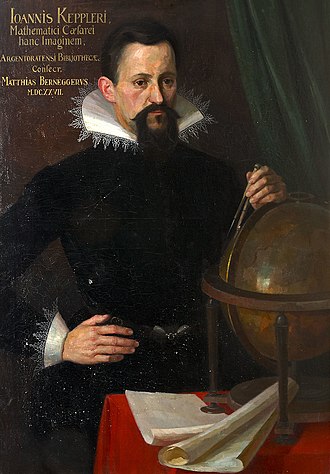
Johannes Kepler
Johannes Kepler was a German astronomer, mathematician, astrologer, natural philosopher and writer on music. He is a key figure in the 17th-century Scientific Revolution, best known for his laws of planetary motion, and his books Astronomia nova, Harmonice Mundi, and Epitome Astronomiae Copernicanae, influencing among others Isaac Newton, providing one of the foundations for his theory of universal gravitation. The variety and impact of his work made Kepler one of the founders and fathers of modern astronomy, the scientific method, natural and modern science. He has been described as the "father of science fiction" for his novel Somnium.
Kepler's Supernova
SN 1604, also known as Kepler's Supernova, Kepler's Nova or Kepler's Star, was a Type Ia supernova that occurred in the Milky Way, in the constellation Ophiuchus. Appearing in 1604, it is the most recent supernova in the Milky Way galaxy to have been unquestionably observed by the naked eye, occurring no farther than 6 kiloparsecs from Earth. Before the adoption of the current naming system for supernovae, it was named for Johannes Kepler, the German astronomer who described it in De Stella Nova.
Ophiuchus
Ophiuchus is a large constellation straddling the celestial equator. Its name comes from the Ancient Greek ὀφιοῦχος (ophioûkhos), meaning "serpent-bearer", and it is commonly represented as a man grasping a snake. The serpent is represented by the constellation Serpens. Ophiuchus was one of the 48 constellations listed by the 2nd-century astronomer Ptolemy, and it remains one of the 88 modern constellations. An old alternative name for the constellation was Serpentarius.