King George III expands on his Proclamation of Rebellion in the Thirteen Colonies in his speech from the throne at the opening of Parliament.
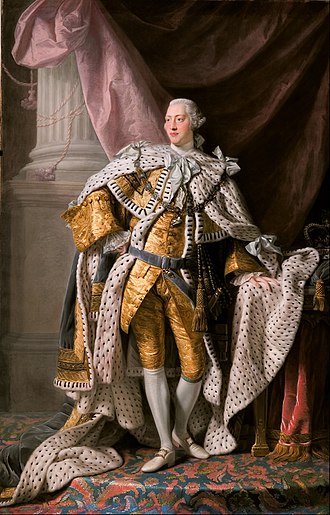
George III
George III was King of Great Britain and Ireland from 25 October 1760 until his death in 1820. The Acts of Union 1800 unified Great Britain and Ireland into the United Kingdom of Great Britain and Ireland, with George as its king. He was concurrently Duke and Prince-elector of Hanover in the Holy Roman Empire before becoming King of Hanover on 12 October 1814. He was the first monarch of the House of Hanover who was born in Great Britain, spoke English as his first language, and never visited Hanover.
Proclamation of Rebellion
The Proclamation of Rebellion, officially titled A Proclamation for Suppressing Rebellion and Sedition, was the response of George III to the news of the Battle of Bunker Hill at the outset of the American Revolutionary War. Issued on 23 August 1775, it declared elements of the American colonies in a state of "open and avowed rebellion". It ordered officials of the empire "to use their utmost endeavours to withstand and suppress such rebellion". The 1775 proclamation of rebellion also encouraged subjects throughout the empire, including those in Britain, to report anyone carrying on "traitorous correspondence" with the rebels to be punished.
October 27
October 27 is the 300th day of the year in the Gregorian calendar; 65 days remain until the end of the year.