Emperor Agustín de Iturbide attempts to dissolve the Congress of the Mexican Empire.
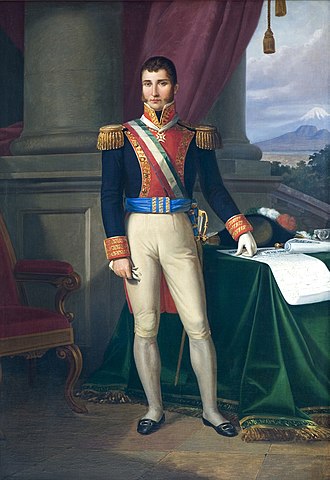
Agustín de Iturbide
Agustín Cosme Damián de Iturbide y Arámburu, commonly known as Agustín de Iturbide and later by his regnal name Agustín I, was the first Emperor of Mexico from 1822 until his abdication in 1823. An officer in the royal Spanish army, during the Mexican War of Independence he initially fought insurgent forces rebelling against the Spanish crown before changing sides in 1820 and leading a coalition of former royalists and long-time insurgents under his Plan of Iguala. The combined forces under Iturbide brought about Mexican independence in September 1821. After securing the secession of Mexico from Spain, Iturbide was proclaimed president of the Regency in 1821; a year later, he was proclaimed Emperor, reigning from 19 May 1822 to 19 March 1823, when he abdicated. In May 1823 he went into exile in Europe. When he returned to Mexico in July 1824, he was arrested and executed.
First Mexican Empire
The Mexican Empire was a constitutional monarchy and the first independent government of Mexico. It was also the only former viceroyalty of the Spanish Empire to establish a monarchy after gaining independence. The empire existed from 1821 to 1823, making it one of the few modern-era independent monarchies in the Americas. To distinguish it from the later Second Mexican Empire (1864–1867) under Emperor Maximilian, this historical period is commonly referred to as the First Mexican Empire. The empire was led by former Royal Spanish military officer Agustín de Iturbide, who ruled as Agustín I.