French Revolution: King Louis XVI is forced to change his residence from Versailles to the Tuileries Palace.
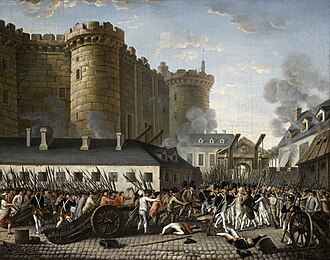
French Revolution
The French Revolution was a period of political and societal change in France which began with the Estates General of 1789 and ended with the Coup of 18 Brumaire on 9 November 1799. Many of the revolution's ideas are considered fundamental principles of liberal democracy, and its values remain central to modern French political discourse. It was caused by a combination of social, political, and economic factors which the existing regime proved unable to manage.
Louis XVI
Louis XVI was the last king of France before the fall of the monarchy during the French Revolution. The son of Louis, Dauphin of France, and Maria Josepha of Saxony, Louis became the new Dauphin when his father died in 1765. In 1770, he married Marie Antoinette. He became King of France and Navarre on his grandfather's death on 10 May 1774, and reigned until the abolition of the monarchy on 21 September 1792. From 1791 onwards, he used the style of king of the French.
Palace of Versailles
The Palace of Versailles is a former royal residence commissioned by King Louis XIV located in Versailles, about 18 kilometres (11 mi) west of Paris, in the Yvelines Department of Île-de-France region in France.
Tuileries Palace
The Tuileries Palace was a palace in Paris which stood on the right bank of the Seine, directly in the west-front of the Louvre Palace. It was the Parisian residence of most French monarchs, from Henri IV to Napoleon III, until it was burned by the Paris Commune in 1871 and demolished in 1883.