Siege of Drogheda ends: Oliver Cromwell's Parliamentarian troops take the town and execute its garrison.
Siege of Drogheda
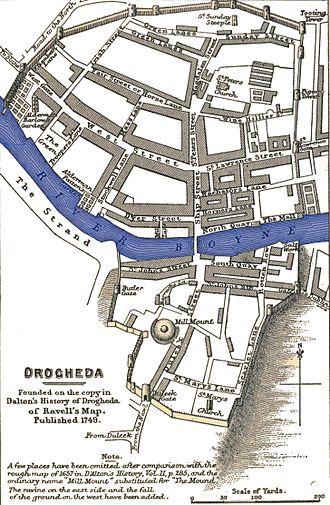
The Siege of Drogheda, 3 to 11 September 1649, took place at the start of the Cromwellian conquest of Ireland. The port of Drogheda was held by a mixed garrison of Irish Catholics and Royalists under the command of Sir Arthur Aston, when it was besieged by English Commonwealth forces under Oliver Cromwell.
Oliver Cromwell
Oliver Cromwell was an English statesman, politician and soldier, widely regarded as one of the most important figures in British history. He came to prominence during the Wars of the Three Kingdoms, initially as a senior commander in the Parliamentarian army and latterly as a politician. A leading advocate of the execution of Charles I in January 1649, which led to the establishment of the Commonwealth of England, Cromwell ruled as Lord Protector from December 1653 until his death.
Roundhead
Roundheads were the supporters of the Parliament of England during the English Civil War (1642–1651). Also known as Parliamentarians, they fought against King Charles I of England and his supporters, known as the Cavaliers or Royalists, who claimed rule by absolute monarchy and the principle of the divine right of kings. The goal of the Roundheads was to give to Parliament the supreme control over executive administration of England.
September 11
September 11 is the 254th day of the year in the Gregorian calendar; 111 days remain until the end of the year.