Gustav Mahler's Symphony No. 8, one of the largest-scale choral works in the classical concert repertoire and popularly known as the "Symphony of a Thousand", was first performed in Munich (1916 performers pictured).
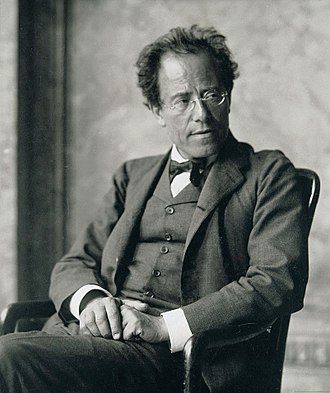
Gustav Mahler
Gustav Mahler was an Austro-Bohemian Romantic composer, and one of the leading conductors of his generation. As a composer he acted as a bridge between the 19th-century Austro-German tradition and the modernism of the early 20th century. While in his lifetime his status as a conductor was established beyond question, his own music gained wide popularity only after periods of relative neglect, which included a ban on its performance in much of Europe during the Nazi era. After 1945 his compositions were rediscovered by a new generation of listeners; Mahler then became one of the most frequently performed and recorded of all composers, a position he has sustained into the 21st century.
Symphony No. 8 (Mahler)
The Symphony No. 8 in E-flat major by Gustav Mahler is one of the largest-scale choral works in the classical concert repertoire. As it requires huge instrumental and vocal forces it is frequently called the "Symphony of a Thousand", although the work is normally presented with far fewer than a thousand performers and Mahler greatly disapproved of the name. The work was composed in a single inspired burst at his Maiernigg villa in southern Austria in the summer of 1906. The last of Mahler's works that was premiered in his lifetime, the symphony was a critical and popular success when he conducted the Munich Philharmonic in its first performance, in Munich, on 12 September 1910.
Classical music
Classical music generally refers to the art music of the Western world, considered to be distinct from Western folk music or popular music traditions. It is sometimes distinguished as Western classical music, as the term "classical music" can also be applied to non-Western art musics. Classical music is often characterized by formality and complexity in its musical form and harmonic organization, particularly with the use of polyphony. Since at least the ninth century, it has been primarily a written tradition, spawning a sophisticated notational system, as well as accompanying literature in analytical, critical, historiographical, musicological and philosophical practices. A foundational component of Western culture, classical music is frequently seen from the perspective of individual or groups of composers, whose compositions, personalities and beliefs have fundamentally shaped its history.