Premiere performance of Gustav Mahler's Symphony No. 8 in Munich (with a chorus of 852 singers and an orchestra of 171 players. Mahler's rehearsal assistant conductor was Bruno Walter).
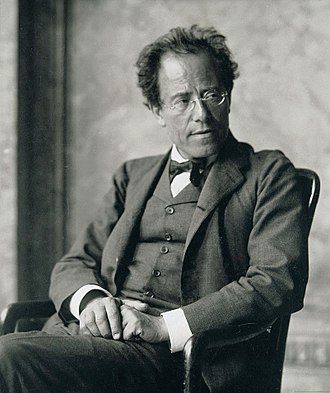
Gustav Mahler
Gustav Mahler was an Austro-Bohemian Romantic composer, and one of the leading conductors of his generation. As a composer he acted as a bridge between the 19th-century Austro-German tradition and the modernism of the early 20th century. While in his lifetime his status as a conductor was established beyond question, his own music gained wide popularity only after periods of relative neglect, which included a ban on its performance in much of Europe during the Nazi era. After 1945 his compositions were rediscovered by a new generation of listeners; Mahler then became one of the most frequently performed and recorded of all composers, a position he has sustained into the 21st century.
Symphony No. 8 (Mahler)
The Symphony No. 8 in E-flat major by Gustav Mahler is one of the largest-scale choral works in the classical concert repertoire. As it requires huge instrumental and vocal forces it is frequently called the "Symphony of a Thousand", although the work is normally presented with far fewer than a thousand performers and Mahler greatly disapproved of the name. The work was composed in a single inspired burst at his Maiernigg villa in southern Austria in the summer of 1906. The last of Mahler's works that was premiered in his lifetime, the symphony was a critical and popular success when he conducted the Munich Philharmonic in its first performance, in Munich, on 12 September 1910.
Conducting
Conducting is the art of directing a musical performance, such as an orchestral or choral concert. It has been defined as "the art of directing the simultaneous performance of several players or singers by the use of gesture." The primary duties of the conductor are to interpret the score in a way that reflects the specific indications in that score, set the tempo, ensure correct entries by ensemble members, and "shape" the phrasing where appropriate. Conductors communicate with their musicians primarily through hand gestures, usually with the aid of a baton, and may use other gestures or signals such as facial expression and eye contact. A conductor usually supplements their direction with verbal instructions to their musicians in rehearsal.