British prime minister Margaret Thatcher gave a landmark speech at the Belfry of Bruges, Belgium, against federalism in the European Economic Community.
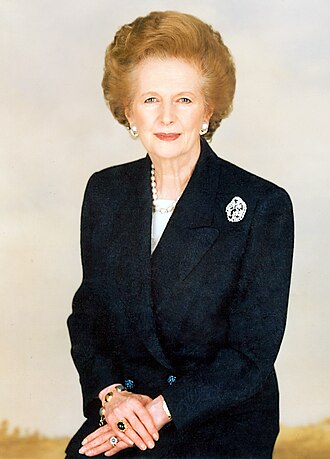
Margaret Thatcher
Margaret Hilda Thatcher, Baroness Thatcher, was a British stateswoman who served as Prime Minister of the United Kingdom from 1979 to 1990 and Leader of the Conservative Party from 1975 to 1990. She was the longest-serving British prime minister of the 20th century and the first woman to hold the position. As prime minister, she implemented policies that came to be known as Thatcherism. A Soviet journalist dubbed her the "Iron Lady", a nickname that became associated with her uncompromising politics and leadership style.
Bruges speech
The Bruges speech was given by British prime minister Margaret Thatcher to the College of Europe at the Belfry of Bruges, Belgium, on 20 September 1988. Thatcher was opposed to any moves to transition the European Economic Community (EEC) into a federal Europe that would take powers away from its members. She considered European Commission president Jacques Delors a campaigner for federalisation and clashed with him publicly. Earlier in 1988, Delors had reaffirmed his commitment for the EEC to take a greater role in establishing European economic, fiscal and social legislation, which Thatcher considered provocative. On 8 September, Delors spoke to Britain's Trades Union Congress, calling for their support.
Belfry of Bruges
The Belfry of Bruges is a medieval bell tower in the centre of Bruges, Belgium. One of the city's most prominent symbols, the belfry formerly housed a treasury and the municipal archives and served as an observation post for spotting fires and other dangers.
Federal Europe
A federal Europe, also referred to as the United States of Europe (USE) or a European federation, is a hypothetical scenario of European integration leading to the formation of a sovereign superstate, organised as a federation of the member countries of the European Union (EU), as contemplated by political scientists, politicians, geographers, historians, futurologists and fiction writers. At present, while the EU is not officially a federation or even a confederation, most contemporary scholars of federalism view the EU as a federal system, a supranational union, which has a flexible membership and competence delegation.