Harold Godwinson defeated King Harald III of Norway and his English ally Tostig Godwinson at the Battle of Stamford Bridge, ending the last Norse invasion of the British Isles.
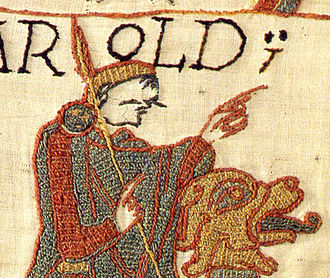
Harold Godwinson
Harold Godwinson, also called Harold II, was the last crowned Anglo-Saxon King of England. Harold reigned from 6 January 1066 until his death at the Battle of Hastings on 14 October 1066, the decisive battle of the Norman Conquest. He was succeeded by William the Conqueror, the victor at Hastings.
Harald Hardrada
Harald Sigurdsson, also known as Harald III of Norway and given the epithet Hardrada in the sagas, was King of Norway from 1046 to 1066. He unsuccessfully claimed the Danish throne until 1064 and the English throne in 1066. Before becoming king, Harald spent 15 years in exile as a mercenary and military commander in Kievan Rus' and chief of the Varangian Guard in the Byzantine Empire. In his chronicle, Adam of Bremen called him the "Thunderbolt of the North".
Tostig Godwinson
Tostig Godwinson was an Anglo-Saxon Earl of Northumbria and brother of King Harold Godwinson. After being exiled by his brother, Tostig supported the Norwegian king Harald Hardrada's invasion of England, and was killed alongside Hardrada at the Battle of Stamford Bridge in 1066.
Battle of Stamford Bridge
The Battle of Stamford Bridge took place at the village of Stamford Bridge, East Riding of Yorkshire, in England, on 25 September 1066, between an English army under King Harold Godwinson and an invading Norwegian force led by King Harald Hardrada and the English king's brother Tostig Godwinson. After a bloody battle, both Hardrada and Tostig, along with most of the Norwegians, were killed. Although Harold Godwinson repelled the Norwegian invaders, his army was defeated by the Normans at Hastings less than three weeks later. The battle has traditionally been presented as symbolising the end of the Viking Age, although major Scandinavian campaigns in Britain and Ireland occurred in the following decades, such as those of King Sweyn Estrithson of Denmark in 1069–1070 and King Magnus Barefoot of Norway in 1098 and 1102–1103.