Ottoman wars in Europe: Ottoman forces under Bayezid I defeated a Christian alliance led by Sigismund of Hungary near present-day Nikopol, Bulgaria.
Ottoman wars in Europe
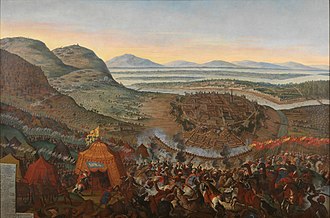
A series of military conflicts between the Ottoman Empire and various European states took place from the Late Middle Ages up through the early 20th century. The earliest conflicts began during the Byzantine–Ottoman wars, waged in Anatolia in the late 13th century before entering Europe in the mid-14th century with the Bulgarian–Ottoman wars. The mid-15th century saw the Serbian–Ottoman wars and the Albanian-Ottoman wars. Much of this period was characterized by the Ottoman expansion into the Balkans. The Ottoman Empire made further inroads into Central Europe in the 15th and 16th centuries, culminating in the peak of Ottoman territorial claims in Europe.
Ottoman Empire
The Ottoman Empire, also called the Turkish Empire, was an imperial realm that controlled much of Southeast Europe, West Asia, and North Africa from the 14th to early 20th centuries; it also controlled parts of southeastern Central Europe, between the early 16th and early 18th centuries.
Bayezid I
Bayezid I, also known as Bayezid the Thunderbolt, was the sultan of the Ottoman Empire from 1389 to 1402. He adopted the title of Sultan-i Rûm, Rûm being the Arabic name for the Eastern Roman Empire.
Battle of Nicopolis
The Battle of Nicopolis took place on 25 September 1396 and resulted in the rout of an allied Crusader army at the hands of an Ottoman force, raising the siege of the Danubian fortress of Nicopolis and leading to the end of the Second Bulgarian Empire. It is often referred to as the Crusade of Nicopolis as it was one of the last big Crusades of the Middle Ages, together with the Crusade of Varna in 1443–1444. By their victory at Nicopolis, the Turks discouraged the formation of European coalitions against them. They maintained their pressure on Constantinople, tightened their control over the Balkans, and became a greater threat to Central Europe.