Martin Ryle, English astronomer and author, Nobel Prize laureate (died 1984)
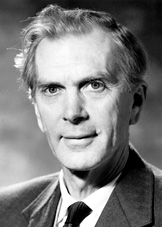
Martin Ryle
Sir Martin Ryle was an English radio astronomer who developed revolutionary radio telescope systems and used them for accurate location and imaging of weak radio sources. In 1946 Ryle and Derek Vonberg were the first people to publish interferometric astronomical measurements at radio wavelengths. With improved equipment, Ryle observed the most distant known galaxies in the universe at that time. He was the first Professor of Radio Astronomy in the University of Cambridge and founding director of the Mullard Radio Astronomy Observatory. He was the twelfth Astronomer Royal from 1972 to 1982. Ryle and Antony Hewish shared the Nobel Prize for Physics in 1974, the first Nobel prize awarded in recognition of astronomical research. In the 1970s, Ryle turned the greater part of his attention from astronomy to social and political issues which he considered to be more urgent. He was also an enthusiastic amateur radio operator.
Nobel Prize in Physics
The Nobel Prize in Physics is an annual award given by the Royal Swedish Academy of Sciences for those who have made the most outstanding contributions to mankind in the field of physics. It is one of the five Nobel Prizes established by the will of Alfred Nobel in 1895 and awarded since 1901, the others being the Nobel Prize in Chemistry, Nobel Prize in Literature, Nobel Peace Prize, and Nobel Prize in Physiology or Medicine. Physics is traditionally the first award presented in the Nobel Prize ceremony.