events
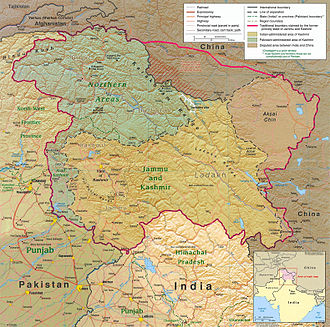
The 2016 Uri attack was carried out on 18 September 2016 by four militants from Jaish-e-Mohammed against an Indian Army brigade headquarters near the town of Uri in the Indian Jammu and Kashmir. 19 Indian soldiers were killed in the attack, and 19–30 others were injured. It was reported by the BBC as having been "the deadliest attack on security forces in Kashmir in two decades".
The Indian Army (IA) is the land-based branch and largest component of the Indian Armed Forces, making it the world's second-largest army and the fourth most powerful military globally. The President of India is the Supreme Commander of the Indian Army, and its professional head is the Chief of the Army Staff (COAS). The Indian Army was established on 1 April 1895 alongside the long established presidency armies of the East India Company, which too were absorbed into it in 1903. Some princely states maintained their own armies which formed the Imperial Service Troops which, along with the Indian Army formed the land component of the Armed Forces of the Crown of India, responsible for the defence of the Indian Empire. The Imperial Service Troops were merged into the Indian Army after independence. The units and regiments of the Indian Army have diverse histories and have participated in several battles and campaigns around the world, earning many battle and theatre honours before and after Independence.
On 29 September 2016, teams of Indian Army Para crossed the Line of Control into Pakistani-administered Kashmir to attack targets up to a kilometer within territory held by Pakistan. The raid occurred ten days after four militants had attacked an Indian army outpost at Uri on 18 September 2016 in the Indian state of Jammu and Kashmir, and killed 19 soldiers. Estimates of casualties among the militants and Pakistan army, from India's cross-border attack varied, with figures of 35 to 40 being reported. The Pakistani government eventually acknowledged the deaths of two soldiers and injuries to nine, while one Indian soldier was captured.
Azad Jammu and Kashmir, abbreviated as AJK and colloquially referred to as simply Azad Kashmir, is a region administered by Pakistan as a nominally self-governing entity and constituting the western portion of the larger Kashmir region, which has been the subject of a dispute between India and Pakistan since 1947. On its eastern side, Azad Kashmir is separated from the Indian–administered territory of Jammu and Kashmir by the Line of Control (LoC), which serves as the de facto border between the Indian- and Pakistani-controlled parts of Kashmir. Azad Kashmir borders with the Pakistani–administered Gilgit–Baltistan to the north; it shares borders with the Pakistani provinces of Punjab and Khyber Pakhtunkhwa to the south and west, respectively. Geographically, it covers a total area of 13,297 km2 (5,134 sq mi) and has a total population of over 4.045 million as per the 2017 national census.
September 29 is the 272nd day of the year in the Gregorian calendar; 93 days remain until the end of the year.