The Hindenburg Line is broken by an Allied attack in World War I.
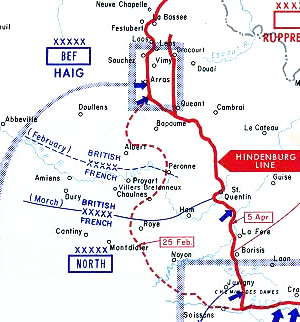
Hindenburg Line
The Hindenburg Line was a German defensive position built during the winter of 1916–1917 on the Western Front in France during the First World War. The line ran from Arras to Laffaux, near Soissons on the Aisne. In 1916, the Battle of Verdun and the Battle of the Somme left the German western armies exhausted and on the Eastern Front, the Brusilov Offensive had inflicted huge losses on the Austro-Hungarian armies and forced the Germans to take over more of the front. The declaration of war by Romania had placed additional strain on the German army and war economy.
Battle of St Quentin Canal
The Battle of St Quentin Canal was a pivotal battle of World War I that began on 29 September 1918 and involved British, Australian and American forces operating as part of the British Fourth Army under the overall command of General Sir Henry Rawlinson. Further north, part of the British Third Army also supported the attack. South of the Fourth Army's 19 km (12 mi) front, the French First Army launched a coordinated attack on a 9.5 km (6 mi) front. The objective was to break through one of the most heavily defended stretches of the German Siegfriedstellung, which in this sector used the St Quentin Canal as part of its defences. The assault achieved its objectives, resulting in the first full breach of the Hindenburg Line, in the face of heavy German resistance. In concert with other attacks of the Grand Offensive along the length of the line, Allied success convinced the German high command that there was little hope of an ultimate German victory.
September 29
September 29 is the 272nd day of the year in the Gregorian calendar; 93 days remain until the end of the year.