World War I: The first tank prototype, developed by William Foster & Co. for the British army, was completed and given its first test drive.
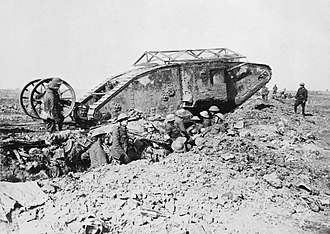
British heavy tanks of the First World War
British heavy tanks were a series of related armoured fighting vehicles developed by the UK during the First World War. The Mark I was the world's first tank, a tracked, armed, and armoured vehicle, to enter combat. The name "tank" was initially a code name to maintain secrecy and disguise its true purpose. The tank was developed in 1915 to break the stalemate of trench warfare. It could survive the machine gun and small-arms fire in "no man's land", travel over difficult terrain, crush barbed wire, and cross trenches to assault fortified enemy positions with powerful armament. Tanks also carried supplies and troops.
William Foster & Co.
William Foster & Co Ltd was an agricultural machinery company based in Lincoln, Lincolnshire, England often called "Fosters of Lincoln." The company can be traced back to 1846, when William Foster purchased a flour mill in Lincoln. William Foster then proceeded to start small scale manufacturing of mill machinery and threshing machinery. The mill was converted to an iron foundry by 1856, thus becoming the original Wellington Foundry. By 1899 the works had moved to the Wellington foundry in New Boultham and the original works were then occupied by William Rainforth. During the First World War Fosters built some of the first tanks for the British Army.
September 6
September 6 is the 249th day of the year in the Gregorian calendar; 116 days remain until the end of the year.