Hans Spemann, German embryologist and academic, Nobel Prize laureate (born 1869)
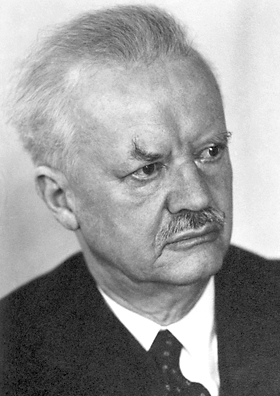
Hans Spemann
Hans Spemann was a German embryologist who was awarded a Nobel Prize in Physiology or Medicine in 1935 for his student Hilde Mangold's discovery of the effect now known as embryonic induction, an influence, exercised by various parts of the embryo, that directs the development of groups of cells into particular tissues and organs, one of the first steps towards cloning. Spemann added his name as an author to Hilde Mangold's dissertation and won a Nobel Prize for her work.
Nobel Prize in Physiology or Medicine
The Nobel Prize in Physiology or Medicine is awarded yearly by the Nobel Assembly at the Karolinska Institute for outstanding discoveries in physiology or medicine. The Nobel Prize is not a single prize, but five separate prizes that, according to Alfred Nobel's 1895 will, are awarded "to those who, during the preceding year, have conferred the greatest benefit to humankind". Nobel Prizes are awarded in the fields of Physics, Medicine or Physiology, Chemistry, Literature, and Peace.