The Battle of Tagliacozzo marks the fall of the Hohenstaufen family from the Imperial and Sicilian thrones, and leading to the new chapter of Angevin domination in Southern Italy.
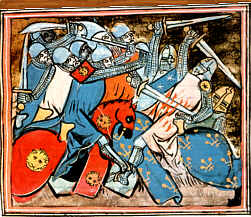
Battle of Tagliacozzo
The Battle of Tagliacozzo was fought on 23 August 1268 between the Ghibelline supporters of Conradin of Hohenstaufen and the Guelph army of Charles of Anjou. The battle represented the last act of Hohenstaufen power in Italy. The capture and execution of Conradin several months after the battle also marked the fall of the family from the Imperial and Sicilian thrones, leading to the new chapter of Angevin domination in Southern Italy.
Hohenstaufen
The Hohenstaufen dynasty, also known as the Staufer, was a noble family of unclear origin that rose to rule the Duchy of Swabia from 1079, and to royal rule in the Holy Roman Empire during the Middle Ages from 1138 until 1254. The dynasty's most prominent rulers – Frederick I (1155), Henry VI (1191) and Frederick II (1220) – ascended the imperial throne and also reigned over Italy and Burgundy. The non-contemporary name of 'Hohenstaufen' is derived from the family's Hohenstaufen Castle on Hohenstaufen mountain at the northern fringes of the Swabian Jura, near the town of Göppingen. Under Hohenstaufen rule, the Holy Roman Empire reached its greatest territorial extent from 1155 to 1268.
Holy Roman Empire
The Holy Roman Empire, also known as the Holy Roman Empire of the German Nation after 1512, was a polity in Central and Western Europe, usually headed by the Holy Roman Emperor. It developed in the Early Middle Ages, and lasted for a millennium until its dissolution in 1806 during the Napoleonic Wars. For most of its history the Empire comprised the entirety of the modern countries of Germany, Czechia, Austria, the Netherlands, Switzerland, Slovenia, and Luxembourg, most of north-central Italy and southern Belgium, and large parts of modern-day east France and west Poland.
Kingdom of Sicily
The Kingdom of Sicily was a state that existed in Sicily and the southern Italian Peninsula as well as, for a time, in Northern Africa, from its founding by Roger II of Sicily in 1130 until 1816. It was a successor state of the County of Sicily, which had been founded in 1071 during the Norman conquest of the southern peninsula. The island was divided into three regions: Val di Mazara, Val Demone and Val di Noto.