Canadian Confederation: Rupert's Land and the North-Western Territory are transferred to Canada from the Hudson's Bay Company, and the province of Manitoba and the Northwest Territories are established from these vast territories.
Canadian Confederation
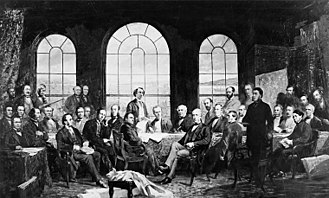
Canadian Confederation was the process by which three British North American provinces—the Province of Canada, Nova Scotia, and New Brunswick—were united into one federation, called the Dominion of Canada, on July 1, 1867. This process occurred with the rising tide of Canadian nationalism that was then beginning to swell within these provinces and others. It reached fruition through the British North America Act, 1867 which had been based on resolutions agreed to by colonial delegates in the 1864 Quebec Conference, later finalized in the 1866 London Conference.
Rupert's Land
Rupert's Land, or Prince Rupert's Land, was a territory in British America based on the Hudson Bay drainage basin. The right to "sole trade and commerce" over Rupert's Land was granted to Hudson's Bay Company (HBC), based at York Factory, effectively giving that company a commercial monopoly over the area. The territory operated for 200 years from 1670 to 1870. Its namesake was Prince Rupert of the Rhine, who was a nephew of King Charles I and the first governor of HBC. In December 1821, the HBC monopoly was extended from Rupert's Land to the Pacific coast.
North-Western Territory
The North-Western Territory was a region of British North America extant until 1870 and named for where it lay in relation to Rupert's Land.
Hudson's Bay Company
The Hudson's Bay Company (HBC) is a Canadian holding company of department stores and commercial property. It is the oldest corporation in North America, founded in 1670 and liquidated in 2025, and was headquartered in Toronto and New York City. Its intellectual property is owned by Canadian Tire as of June 2025.