Russian Revolution: Tsar Nicholas II and his family (pictured) were murdered by Bolsheviks at Yekaterinburg.
Russian Revolution
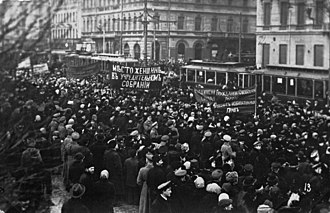
The Russian Revolution was a period of political and social change in Russia, starting in 1917. This period saw Russia abolish its monarchy and adopt a socialist form of government following two successive revolutions and a civil war. It can be seen as the precursor for other revolutions that occurred in the aftermath of World War I, such as the German Revolution of 1918–1919. The Russian Revolution was a key event of the 20th century.
Nicholas II
Nicholas II was the last reigning Emperor of Russia, King of Congress Poland, and Grand Duke of Finland from 1 November 1894 until his abdication on 15 March 1917. He married Alix of Hesse and had five children: the OTMA sisters – Olga, born in 1895, Tatiana, born in 1897, Maria, born in 1899, and Anastasia, born in 1901 — and the tsesarevich Alexei Nikolaevich, who was born in 1904.
Murder of the Romanov family
The abdicated Russian Imperial Romanov family were shot and bayoneted to death by Bolshevik revolutionaries under Yakov Yurovsky on the orders of the Ural Regional Soviet in Yekaterinburg on the night of 16–17 July 1918. Also murdered that night were members of the imperial entourage who had accompanied them: court physician Eugene Botkin; lady-in-waiting Anna Demidova; footman Alexei Trupp; and head cook Ivan Kharitonov. The bodies were taken to the Koptyaki forest, where they were stripped, mutilated with grenades and acid to prevent identification, and buried.
Bolsheviks
The Bolsheviks, led by Vladimir Lenin, were a radical faction of the Marxist Russian Social Democratic Labour Party (RSDLP) which split with the Mensheviks at the Second Party Congress in 1903. The Bolshevik party, formally established in 1912, seized power in Russia in the October Revolution of 1917, and was later renamed the Russian Communist Party, All-Union Communist Party, and ultimately the Communist Party of the Soviet Union. Its ideology, based on Leninist and later Marxist–Leninist principles, became known as Bolshevism.