After traveling through the Louisiana Purchase and reaching the Pacific Ocean, explorers Lewis and Clark and their Corps of Discovery begin their arduous journey home.
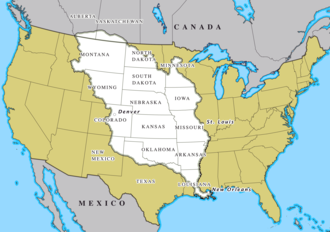
Louisiana Purchase
The Louisiana Purchase was the acquisition of the territory of Louisiana by the United States from the French First Republic in 1803. This consisted of most of the land in the Mississippi River's drainage basin west of the river. In return for fifteen million dollars, or approximately eighteen dollars per square mile ($7/km2), the United States nominally acquired a total of 828,000 sq mi now in the Central United States. However, France only controlled a small fraction of this area, most of which was inhabited by Native Americans; effectively, for the majority of the area, the United States bought the preemptive right to obtain Indian lands by treaty or by conquest, to the exclusion of other colonial powers.
Lewis and Clark Expedition
The Lewis and Clark Expedition, also known as the Corps of Discovery Expedition, was the United States expedition to cross the newly acquired western portion of the country after the Louisiana Purchase. The Corps of Discovery was a select group of U.S. Army and civilian volunteers under the command of Captain Meriwether Lewis and his close friend Second Lieutenant William Clark. Clark, along with 30 others, set out from Camp Dubois, Illinois, on May 14, 1804, met Lewis and ten other members of the group in St. Charles, Missouri, then went up the Missouri River. The expedition crossed the Continental Divide of the Americas near the Lemhi Pass, eventually coming to the Columbia River, and the Pacific Ocean in 1805. The return voyage began on March 23, 1806, at Fort Clatsop, Oregon, ending six months later on September 23 of that year.
Corps of Discovery
The Corps of Discovery was a specially established unit of the United States Army which formed the nucleus of the Lewis and Clark Expedition that took place between May 1804 and September 1806. The Corps was led jointly by Captain Meriwether Lewis and Second Lieutenant William Clark. Commissioned by President Thomas Jefferson, the Corps' objectives were scientific and commercial — to study the area's plants, animal life, and geography, and to learn how the Louisiana Purchase could be exploited economically. Aside from its military composition, the Corps' additional personnel included scouts, boatmen, and civilians.